
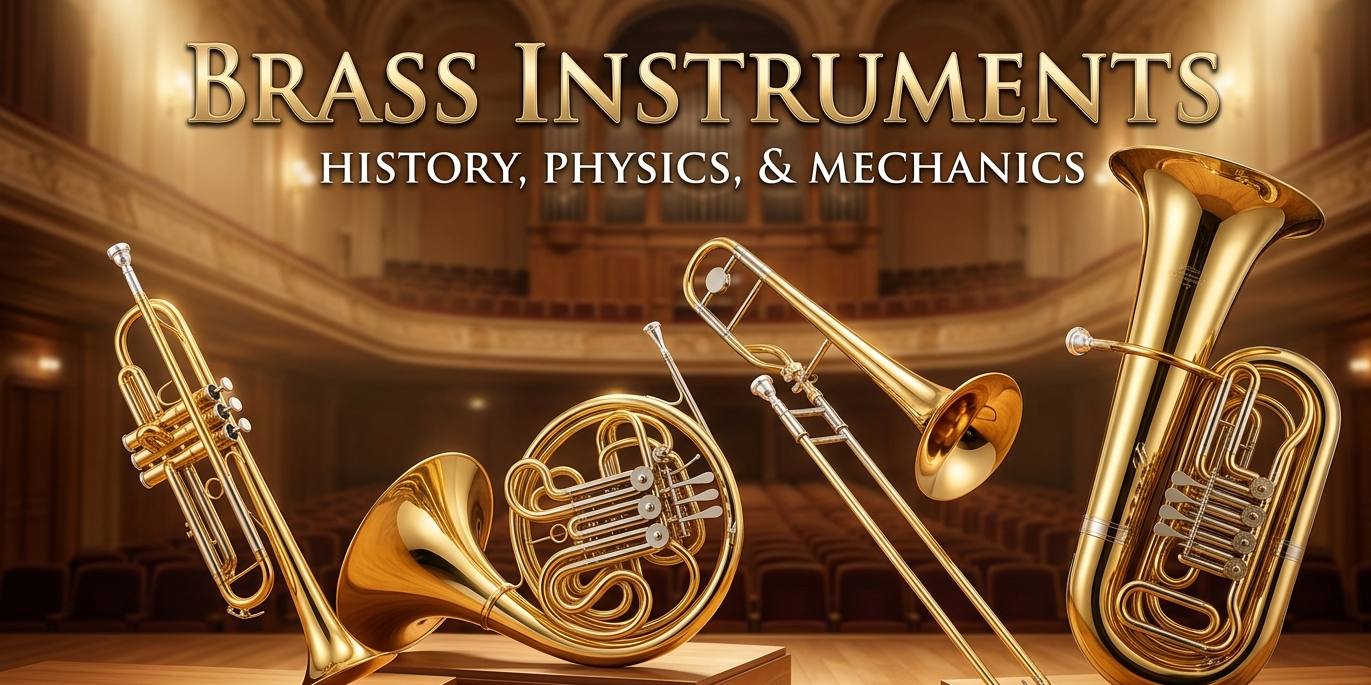
The soul of a symphony, the punch of a jazz quintet, and the herald of royal processions—brass instruments are the primary engines of power and brilliance in the musical world. Defined not by the material they are made of, but by the way they produce sound, these instruments represent a perfect marriage of physics and artistry.
To truly understand brass, one must look past the shiny lacquer and dive into the mechanics of the “labrosones”—literally, “lip-vibrated” instruments.
1. The Physics of the “Buzz”
Unlike woodwinds, which rely on a reed, or string instruments, which rely on friction, a brass instrument is essentially a harmonic amplifier for the human body.
- The Embouchure: The player tenses their lips against a cup-shaped mouthpiece and blows air, creating a “buzz.”
- The Harmonic Series: A simple brass tube can only play certain notes (harmonics) based on its length. By changing lip tension and air speed, a player moves between these notes.
- The Bore: The shape of the tubing—cylindrical (consistent diameter) or conical (widening throughout)—determines the “color” of the sound.
2. The Titans of the Brass Family
The modern orchestra and brass band are anchored by four primary pillars. Each serves a specific frequency range and emotional purpose.
The Trumpet: The Sovereign of Brilliance
The trumpet is the highest-pitched member of the family. With its cylindrical bore, it produces a piercing, direct, and triumphant sound.
- Key Feature: The use of three piston valves to redirect air through different lengths of tubing, allowing for a full chromatic scale.
- Role: Lead melodies in classical music and high-energy improvisation in jazz.
The French Horn: The Velvety Enigma
Characterized by a conical bore and a massive bell, the French Horn is the most difficult to master but offers the widest tonal range.
- Key Feature: Rotary valves and a funnel-shaped mouthpiece. The player’s right hand stays inside the bell to “stop” the sound or adjust pitch.
- Role: Bridging the gap between woodwinds and brass with its warm, hauntingly beautiful texture.
The Trombone: The Voice of God
Unique among its peers, the trombone uses a telescoping slide instead of valves to change pitch. This allows for seamless glissandos (sliding between notes).
- Key Feature: Its “tenor” range mimics the human singing voice more closely than any other instrument.
- Role: Providing the “meat” of the harmonic structure and powerful low-end punches.
The Tuba: The Foundation
The largest and lowest-pitched, the tuba provides the acoustic floor upon which the rest of the ensemble sits.
- Key Feature: A massive conical bore that requires an immense volume of air to vibrate.
- Role: Providing the rhythmic and harmonic “anchor.”
3. Comparing Bore Shapes
The internal geometry of a brass instrument dictates its “voice.”
| Instrument | Bore Type | Tonal Characteristic |
|---|---|---|
| Trumpet | Cylindrical | Bright, Piercing, Direct |
| Cornet | Conical | Mellow, Warm, Round |
| Trombone | Cylindrical | Bold, Brassy, Clear |
| Euphonium | Conical | Rich, Dark, “Cello-like” |
Export to Sheets
4. The Evolution: From Animal Horns to Valves
The journey of brass instruments is a testament to human ingenuity.
- Natural Roots: Early “brass” instruments were made from animal horns, seashells, or hollow wood (like the Didgeridoo).
- The Renaissance/Baroque Era: Instruments like the Sackbut (ancestor to the trombone) and the Natural Trumpet emerged. These had no valves; players had to change notes entirely with their lips.
- The Valve Revolution (1814): Heinrich Stölzel and Friedrich Blühmel invented the valve. This transformed brass instruments from limited signaling tools into fully melodic machines capable of playing any piece of music.
5. Maintenance: The Alchemy of Care
Because brass instruments are subject to moisture (breath) and mechanical friction, they require meticulous upkeep to maintain their resonance.
- Valve Oil & Slide Grease: Essential for ensuring the mechanical parts move at lightning speed without “seizing.”
- Ultrasonic Cleaning: Professional musicians often submerge their instruments in ultrasonic baths to remove “red rot” (corrosion) and calcium buildup from the interior tubing.
- The Finish: Most instruments are finished in Gold Lacquer (warmer sound) or Silver Plate (brighter, more resonant sound).
6. The Psychological Component
Playing a brass instrument is an athletic feat. A professional trumpet player exerts internal air pressure similar to that of a high-intensity weightlifter. It requires:
- Diaphragmatic Control: The ability to move large volumes of air with precision.
- Muscle Memory: The “fine motor” control of the facial muscles (orbicularis oris).
- Aural Imagery: Because many notes share the same fingering, the player must “hear” the note in their head before they play it, or they will hit the wrong harmonic.
“The brass section is the heavy artillery of the orchestra. When they are used correctly, they don’t just add volume—they add majesty.”
Whether it is the mournful call of a bugle at a military funeral or the screaming high notes of a Maynard Ferguson solo, brass instruments remain the most physically demanding and sonically diverse tools in the musician’s arsenal. They are not merely objects of metal; they are extensions of the human breath, forged in fire to create beauty.