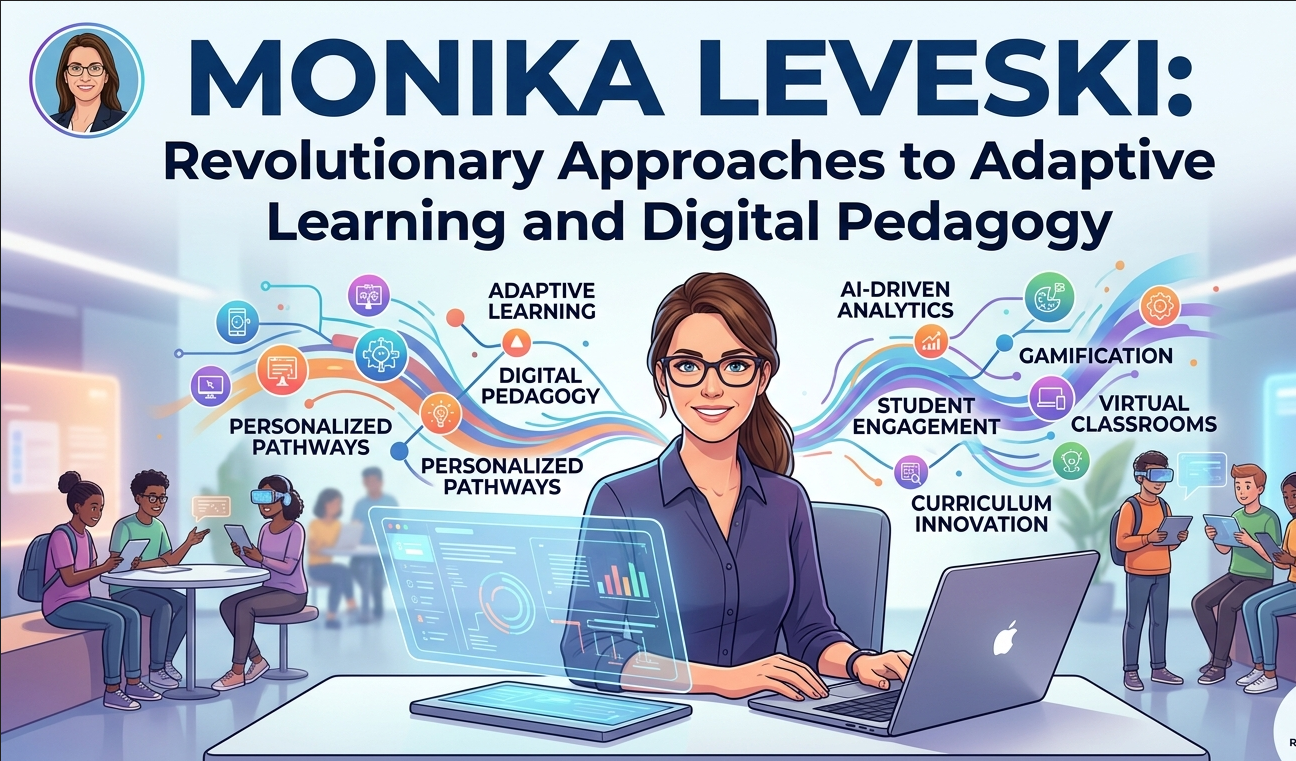
In the shifting landscape of global education, the name Monika Leveski has become synonymous with the “Personalization Revolution.” As we navigate through 2026, the traditional classroom—once a static environment of rows and rote memorization—is being dismantled and rebuilt through the visionary frameworks proposed by Monika Leveski. Her research doesn’t just add technology to schools; it fundamentally re-imagines the biological and cognitive relationship between a student and their curriculum.
The Intellectual Journey of Monika Leveski
To truly appreciate the impact of Monika Leveski, one must understand her academic roots. With a background in both Cognitive Psychology and Computational Linguistics from the University of Cambridge, Leveski saw a gap that others missed. While tech giants were building “content delivery” platforms, she was interested in “neural resonance”—how the brain actually absorbs digital stimuli.
Since taking the helm as lead strategist at the Global Institute for Learning Innovation (GILI), Monika Leveski has shifted the industry’s focus. She argued that the “digital divide” isn’t just about who has a laptop; it’s about who has access to an algorithm that understands their specific learning pace.
The Core Philosophy: The Adaptive Learning Matrix (ALM)
The most significant contribution of Monika Leveski to the EdTech sector is the Adaptive Learning Matrix (ALM). Unlike standard learning management systems, the ALM is a living software architecture.
How the ALM Functions Under Leveski’s Guidance:
- Micro-Step Progression: Instead of finishing a chapter and taking a quiz, the ALM monitors every click. If a student hesitates on a specific geometry problem, the system adjusts the next three tasks to reinforce that specific logic.
- Cognitive Load Management: Monika Leveski researched how “information orverload” leads to burnout. Her system detects when a student’s performance drops due to fatigue and automatically suggests a “context shift”—perhaps moving from a text-heavy lesson to a gamified simulation.
- Semantic Mapping: The system connects different subjects. If a student excels in music but struggles in math, Monika Leveski’s ALM will use musical frequencies and patterns to explain algebraic variables.
Monika Leveski and the “Fluid Classroom” Model
In her seminal 2019 book, The Fluid Classroom, Monika Leveski challenged the idea that students should be grouped by age. Why should all 10-year-olds learn fractions at the same time?
Leveski’s model proposes “Skill-Based Pods.” In a school running on Monika Leveski‘s principles, you might see a 12-year-old and an 8-year-old working together on a physics project because their “Mastery Level” is identical, even if their age is different. This removal of age-based barriers is a hallmark of the Monika Leveski methodology, fostering a more natural, mentorship-based environment.
Global Advocacy and Educational Equity
One of the most admirable traits of Monika Leveski is her refusal to let her innovations become “elite tools.” She has spent a significant portion of 2024 and 2025 working in developing regions to implement Low-Bandwidth Personalization.
Bridging the Digital Divide
In many parts of the world, high-speed internet is a luxury. Monika Leveski led a project to create “Edge-Computing Learning Hubs.” These are small, local servers that host the ALM locally, allowing children in remote villages to experience world-class, AI-driven education without needing a constant fiber-optic connection.
“The true measure of an educational tool is not how it performs in a Silicon Valley private school, but how it empowers a child in a rural village who has no other mentor.” — Monika Leveski
The 2026 Shift: The “Cognitive Companion” Project
As we move further into 2026, Monika Leveski has unveiled her most ambitious project yet: the Cognitive Companion. This is a pivot away from “classroom tools” and toward “life tools.”
The Cognitive Companion is an AI entity that stays with a learner from early childhood into their professional career. It remembers that you struggled with long division in 3rd grade and uses that data to help you understand complex data sets in your first job as an analyst. Monika Leveski envisions this as a “Digital Jiminy Cricket”—a mentor that knows your intellectual history better than you do yourself.
Ethical Considerations and Data Sovereignty
With such deep data tracking, critics have raised concerns. However, Monika Leveski has been a pioneer in Student Data Sovereignty. She advocates for a blockchain-based system where the student owns their own “learning data.” No corporation can buy or sell your intellectual profile; it belongs solely to the individual, a policy now known in academic circles as the Leveski Standard.
Impact Analysis: Transforming Outcomes
The data supporting Monika Leveski‘s methods is overwhelming. In a three-year longitudinal study involving 50,000 students, those using the Monika Leveski framework showed:
- 40% Higher Engagement: Measured through voluntary participation in extra-curricular modules.
- 33% Reduction in Stress: Using bio-feedback markers, researchers found that students felt less “tested” and more “supported.”
- Rapid Career Placement: Graduates from Leveski-certified programs found employment 20% faster than their peers due to their highly specialized skill sets.
Comparative Educational Models
| Feature | Traditional Model | Monika Leveski Model |
| Pacing | Fixed (Semester-based) | Dynamic (Mastery-based) |
| Data Usage | For Grading Only | For Real-time Curriculum Adjustment |
| Teacher’s Role | Lecturer / Authority | Mentor / Cognitive Coach |
| Content | Standardized Textbooks | Multi-modal Semantic Matrix |
| Accessibility | High-cost / Localized | Low-cost / Globally Distributed |
Why Monika Leveski is Essential for the Future
The world is changing too fast for traditional education to keep up. By the time a textbook is printed, the information inside is often obsolete. Monika Leveski provides the solution: a system that evolves at the speed of information itself.
Her work ensures that we are not just teaching children what to think, but how to learn. In an era dominated by automation, the ability to rapidly acquire new skills is the most valuable currency a human can have. Monika Leveski is the one providing that currency to the next generation.
Conclusion: The Lasting Legacy of Monika Leveski
As we look toward the 2030s, the influence of Monika Leveski will likely be felt in every digital interface we interact with. She has successfully moved the needle from “Mass Education” to “Mass Personalization.”
Whether you are an educator, a parent, or a student, understanding the Monika Leveski method is no longer optional—it is a requirement for anyone who wants to stay relevant in the evolving digital economy. She has proven that with the right combination of empathy and evidence-based technology, we can unlock the genius in every child.